


Maintenance and facilities
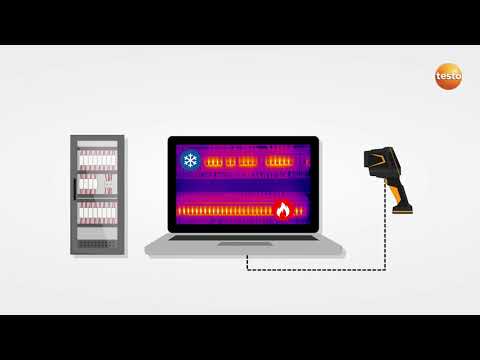
Testo 883 for maintenance and facility management
See how the Testo 883 supports professional maintenance and facility inspection work.
Official Testo video
The Testo 883-1 and Testo 883-2 share the same core thermal imaging, measurement and reporting platform. The deciding difference is the supplied lens: choose the 883-1 for greater detail on individual components, or the 883-2 for wider coverage of buildings and large surfaces at close range. Both are also available in a dual-lens configuration with a 12° × 9° telephoto lens for distant targets.
Tick Add to compare under each product | Open Compare in the bottom-right corner | Check your selection, and press Compare | On the comparison table, select Highlight differences to quickly see where specifications differ
Testo 883-1 vs Testo 883-2: which should you choose?
The Testo 883-1 and 883-2 use the same 320 × 240 infrared detector, produce images up to 640 × 480 with Testo SuperResolution and provide the same <40 mK thermal sensitivity. They also share Testo SiteRecognition, ScaleAssist, ε-Assist, wireless connectivity and the IRSoft analysis and reporting workflow.
The important difference is the field of view of the supplied lens. This determines how much of the inspection scene the camera captures and how many detector pixels are placed across an individual target.
| Testo 883-1 | Testo 883-2 | |
|---|---|---|
| Supplied lens | 30° × 23° standard lens | 42° × 32° wide-angle lens |
| Spatial resolution | 1.7 mrad | 2.3 mrad |
| Best at | Resolving individual components | Capturing larger nearby areas |
| Typical applications | Electrical and mechanical inspection | Building and HVAC inspection |
| Ideal targets | Connections, breakers, bearings, motors and machinery | Walls, windows, roofs, floors and large installations |
| Optional telephoto lens | 12° × 9°, 0.7 mrad | 12° × 9°, 0.7 mrad |
See the Testo 883 in use
Watch official Testo demonstrations covering practical inspections, camera operation, SiteRecognition and IRSoft analysis and reporting.
Maintenance and facilities
See how the Testo 883 supports professional maintenance and facility inspection work.
Official Testo video

Building energy
Explore how the camera supports building surveys, energy assessments and thermal diagnostics.
Official Testo video
Inspection workflow
See how Testo SiteRecognition assigns thermal images to the correct measurement location for structured repeat inspections.
Official Testo video

Analysis and reporting
Learn how to analyse thermograms and produce professional documentation using Testo IRSoft.
Official Testo video

Preventive maintenance
Follow the Testo 883 through a practical preventive-maintenance inspection workflow.
Official Testo video

Building thermography
See the Testo 883 applied to practical building inspection and diagnostic work.
Official Testo video
Choose the Testo 883-1 for component-level detail
The Testo 883-1’s narrower 30° × 23° lens places more detector pixels across a target than the 883-2’s wide-angle lens when both cameras are used from the same position. This makes it the stronger choice when the inspection depends on distinguishing smaller components rather than fitting a large area into one image.
Choose the Testo 883-2 for wider coverage
The Testo 883-2’s 42° × 32° lens captures substantially more of the scene from the same working position. It is designed for situations where the target is physically large or there is not enough room to step farther back.
From approximately two metres away:
The 883-2 therefore fits more of a wall, room or installation into each thermal image. The 883-1 sacrifices that extra width to place more pixels across individual electrical or mechanical components.
These figures are approximate and describe horizontal scene width.
Both models are available with an additional 12° × 9° telephoto lens. Choose the dual-lens configuration when your work includes small or distant targets that cannot be approached closely, including outdoor switchgear, substation components, elevated connections and equipment behind established barriers.
The telephoto lens has a 0.7 mrad spatial resolution, placing substantially more pixels across a distant target than either supplied lens.
Choose:
Testo 883 FAQ
Clear answers to the most common questions about selecting and using the Testo 883-1 and 883-2.
The principal difference is the supplied lens. The Testo 883-1 has a 30° × 23° lens for greater detail on individual targets, while the 883-2 has a 42° × 32° wide-angle lens for capturing larger areas from shorter working distances.
Yes. Both use a 320 × 240 infrared detector and can produce 640 × 480 images using Testo SuperResolution. The lens changes the field of view and spatial resolution, rather than the detector resolution.
The Testo 883-1 is generally the stronger choice for electrical thermography because its 30° lens places more pixels across individual breakers, connections and other components at the same distance. Add the telephoto lens if you also inspect distant or inaccessible electrical assets.
The Testo 883-2 is normally the better choice for building thermography. Its 42° wide-angle lens captures more of walls, windows, floors and rooms where space prevents the operator from stepping farther back.
Both models offer the same optional 12° × 9° telephoto lens. For long-distance work, the relevant choice is therefore the dual-lens configuration rather than the 883-1 or 883-2 camera body alone.
It does not change the camera’s 320 × 240 detector. The telephoto lens provides a narrower field of view and better 0.7 mrad spatial resolution, allowing more detector pixels to be placed across a smaller or more distant target.
Tell us your application, target size and working distance. We’ll help confirm the most suitable camera and lens configuration.